President Trump ordered a substantial cut to upcoming U.S.–South Korea military drills, citing high costs and risky signals to North Korea.
Story Snapshot
- Trump said he told the Pentagon to “substantially reduce” joint exercises with South Korea.
- The order came on the eve of the Ulchi Freedom Shield drills scheduled for Aug. 17–27.
- Trump argued the drills were costly and sent a hostile signal to North Korea.
- Officials had planned readiness training on drones, cyber, and GPS disruption.
What President Trump Ordered and Why It Matters
President Trump said he instructed Secretary of War Pete Hegseth to “substantially reduce” joint military exercises with South Korea. He tied the move to cost and signaling concerns. He argued the drills are expensive and send a hostile message to North Korea at a tense time. The announcement targeted exercises that were already on the calendar. Trump also said North Korea’s leader had been respectful during his time in office, which he framed as a reason to ease signals.
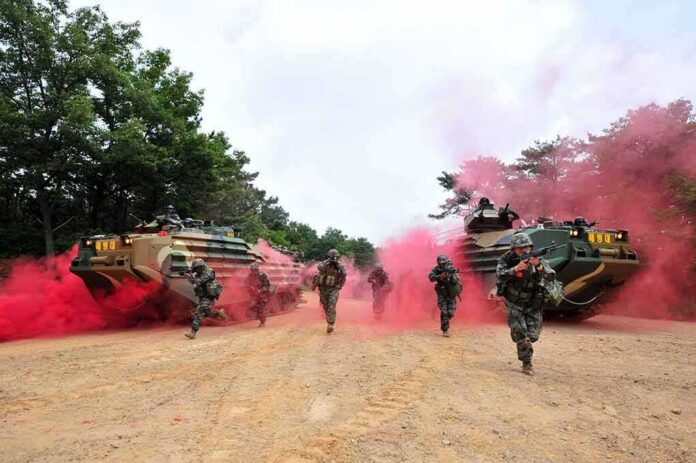
U.S. and South Korean forces had planned to start the Ulchi Freedom Shield exercises on August 17. The training window was set for eleven days. Reuters reporting described scenarios that included counter-drone defense, responses to cyberattacks, and operations under Global Positioning System disruption. These details show a focus on modern threats and rapid response skills for combined forces on the peninsula.
What Was Scheduled for the Drills
The Ulchi Freedom Shield program is designed to test joint readiness against North Korean tactics. Prior coverage also noted live-fire precision targeting, bridging across water, and moving prepositioned gear. These tasks help allied units work together at speed in combat-like conditions. Such drills build shared plans, communications, and logistics under stress. Supporters say this training deters attacks by showing that the alliance can fight and win if needed.
North Korea often denounces these exercises in state media. Days before the start date, Pyongyang criticized the planned drills. That reaction fits a long pattern. North Korea routinely labels the exercises as threats, while the allies describe them as defensive and routine. This clash of messages is part of the yearly cycle on the peninsula and shapes how each side reads risk and intent.
How This Fits a Long Alliance Pattern
Changes to exercise size and timing have happened before during periods of diplomacy. Analysts and past studies note that leaders sometimes reduce drills to lower tensions or create space for talks. Experts disagree on the net effect. Some say larger drills harden deterrence. Others argue they can also provoke more tests or threats from Pyongyang. The record shows both effects can appear, depending on the moment and the scope of training.
South Korea hopes for talks between US and North Korea after Trump downsizes military drills https://t.co/KABM8mlOvV
— News 19 (@whnt) August 17, 2026
Two limits stand out in the current public record. First, Trump’s statement did not include a detailed Pentagon directive in the reporting we have today. Second, “substantially reduce” was not defined in terms of which events, units, or scenarios would change. Officials had not publicly confirmed final execution steps at the time of the initial reports. Those details often emerge later in formal guidance and after-action notes.
What People Across the Spectrum Are Watching
Taxpayers who want tighter budgets will track whether reductions save real money. National security voices will watch if any cut affects readiness or allied trust. People tired of endless tensions will ask if a lighter signal lowers the chance of miscalculation. Critics of the foreign policy “status quo” will look for proof that Washington can recalibrate big systems fast, rather than protect routines first and results second.
What Comes Next on the Ground
Watch for combined forces to adjust schedules, training lanes, or unit participation if the order changes scope. Look for official updates from the Department of Defense or United States Forces Korea that clarify the final plan. Expect North Korean media to claim a win or to demand more concessions. Expect alliance officials to underline that core deterrence remains intact, even if certain activities shrink or shift to simulations or smaller drills.
Sources:
internazionale.it, reuters.com, axios.com, bloomberg.com
© bingeworthynews.com 2026. All rights reserved.