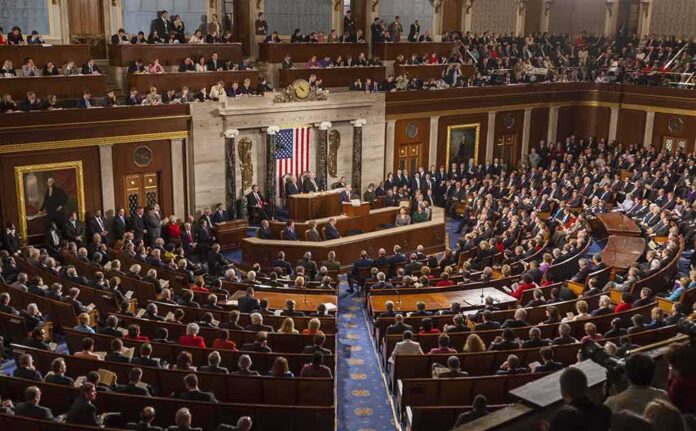
House lawmakers voted 352-72 to cement President Trump’s anti-fraud push by establishing a permanent National Fraud Enforcement Division inside the Justice Department.
Story Highlights
- The House passed H.R. 9576 to create a permanent fraud-fighting division at the Department of Justice.
- The bill names the unit the National Fraud Enforcement Division and sets its mission in law.
- Members tied funding capacity to the new division, citing a $30 million line in House materials.
- Senate action is not yet recorded in public sources, so enactment is pending.
House Passes H.R. 9576 With Overwhelming Bipartisan Support
House records show lawmakers approved H.R. 9576 by a recorded vote of 352-72 on September 16, 2026. The action log on Congress.gov lists the bill as passed in the House and details the roll call result. The measure moved under a structured rule after the House Rules Committee advanced it for floor debate. The vote reflects strong bipartisan support, even with dozens opposed. The legislation now awaits Senate consideration before it can reach President Trump’s desk.
House procedures documented the bill’s path before passage. The Rules Committee reported a rule governing debate, and the Clerk’s floor summary shows same-day activity for H.R. 9576. Those steps confirm that leaders put the bill on the calendar and guided it through a standard process toward a final vote. This procedural record, paired with the roll call, establishes the measure’s legitimacy and momentum as it leaves the House for the Senate.
What The Bill Does: A Permanent Division To Protect Taxpayers
The bill text states, “There is hereby established a National Fraud Enforcement Division within the Department of Justice.” The text also provides for leadership at the Assistant Attorney General level, subject to Senate confirmation, and directs the division to investigate and prosecute fraud against taxpayer funds and taxpayer-backed programs. By writing this into statute, Congress would harden the unit’s mission and keep it focused on stopping waste, abuse, and scams that drain public resources.
House communications emphasize that the division targets fraud tied to federal spending. Supporters say making the unit permanent secures a clear chain of command, dedicated resources, and year-round focus on complex schemes that cross state lines and agencies. A sponsor statement highlighted permanence as the central goal, presenting the division as a standing watchdog for taxpayer dollars rather than a short-term task force that might fade with shifting priorities.
Funding Signal: Capacity To Prosecute And Recover More
Appropriations materials linked the new division to a defined funding stream, referencing $30 million for startup and operations. That figure signals staff, tools, and data capacity to chase sophisticated fraud in health care, tax, trade, and other areas where federal money moves. Supporters argue that steady funding will boost referrals, speed up charging decisions, and help recover more stolen funds for taxpayers. Budget direction also provides clearer oversight and performance expectations for the division.
BREAKING: The House just PASSED legislation to codify into law President Trump's National Fraud Enforcement Division within DOJ
Final vote: 352-72
Once approved by the Senate and signed, this bill will LEGALLY REQUIRE Trump's established anti- Fraud pic.twitter.com/PlPZRDyPjw
— Sergeant News Network (@SGTnewsNetworks) September 17, 2026
Media reports noted that many Democrats joined Republicans to pass the bill, while a smaller bloc opposed it. Coverage framed the vote as a major win for President Trump’s anti-fraud agenda, and as a sign that program integrity still draws cross-party backing. The bipartisan margin suggests that protecting taxpayer funds remains a uniting cause, even amid other fights over spending, immigration, and federal priorities that usually split along party lines.
Why It Matters For Conservative Priorities
Taxpayers deserve government that defends every dollar they send to Washington. A permanent fraud division makes that duty concrete. A named office, a Senate-confirmed leader, and a clear mission reduce excuses and delays. This aligns with limited-government principles: stop theft, focus on core tasks, and demand results. When fraud shrinks, fewer dollars are wasted on bloated programs, and honest families keep more of what they earn. Strong enforcement also deters future scams before they start.
Program fraud hurts seniors, veterans, workers, and small businesses who play by the rules. Centralizing expertise can speed cases and close loopholes. It also helps coordinate with inspectors general and United States Attorneys. This bill does not write new criminal laws. It strengthens the hand of prosecutors to use existing tools faster and smarter. That is common-sense governance: enforce the law, protect the treasury, and restore trust that money goes where Congress intended.
Next Steps: Senate Consideration And Implementation Details
The Senate must act for the bill to become law. Public records so far reflect only House passage. If the Senate sends the bill to President Trump and he signs it, the Department of Justice would organize the new division under the statute. That would include naming leadership, aligning budgets, and setting performance goals on cases, recoveries, and referrals across priority areas that touch federal funds and taxpayer programs.
Supporters and oversight leaders will likely track staffing levels, case throughput, and recoveries to test the division’s impact. House debate materials and future hearings could add data on how the division avoids overlap with existing offices. But the core aim is simple: put fraudsters on notice and defend taxpayers. The House vote delivered that message clearly. The Senate’s decision will now determine how fast those plans become permanent policy.
Sources:
facebook.com, hamadeh.house.gov, congress.gov, hindustantimes.com, docs.house.gov, clerk.house.gov
© bingeworthynews.com 2026. All rights reserved.