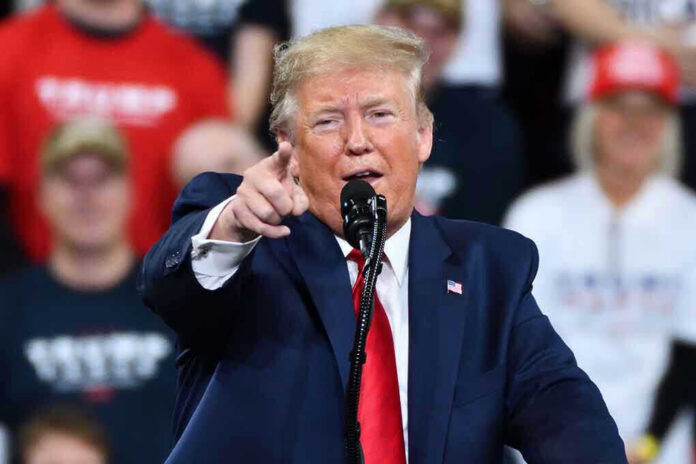
Trump just turned one election bill into a loyalty test that could decide who survives the next Republican primary.
Quick Take
- Trump warned he will not endorse any lawmaker, Republican or Democrat, who votes against the SAVE America Act.
- The House passed the bill in February 2026; the Senate faces a filibuster math problem that likely stalls it.
- The legislation blends election rules (citizenship proof, voter ID, limits on mail voting) with culture-war provisions.
- Republican leaders plan test votes to force Democrats onto the record, even if final passage lacks 60 votes.
Trump’s endorsement threat turns a Senate procedural vote into a political trap
Trump’s Truth Social warning landed as Senate Republicans prepared a procedural test vote on the SAVE America Act, a moment designed less for quiet legislating than for public sorting. Trump framed the bill as historic and drew a bright line: vote no, lose his backing. That message matters because endorsements drive money, activists, and turnout in primaries, especially when a few senators still resist federalizing rules their states already run.
The Senate’s immediate obstacle isn’t a lack of Republican interest; it’s the 60-vote threshold to cut off debate. Majority Leader John Thune has openly acknowledged the arithmetic, and Democrats have promised unified resistance. That reality turns the “test vote” into the real show: a roll call meant to produce clips, mailers, and campaign slogans. For voters, the key question becomes whether this is serious lawmaking or a carefully staged accountability moment.
What the SAVE America Act actually packages together, and why that bundling changes the fight
The bill’s core election provisions sound familiar: proof of U.S. citizenship for federal voter registration, stricter voter identification standards, and tighter limits on mail-in voting. Those measures target a long-running Republican concern that loose processes invite mistakes, fraud, or outright noncitizen participation. The distinguishing move is the bundling. The SAVE America Act also pulls in cultural flashpoints, including transgender-related policies tied to sports and minors’ medical care, expanding the coalition and the controversy at the same time.
Bundling forces senators into all-or-nothing politics. A lawmaker can agree with citizenship verification but dislike federal restrictions on mail voting that states tailor to geography and local needs. Another can support voter ID but balk at tying election administration to social policy. That package design looks intentional: it raises the stakes and makes it harder for fence-sitters to claim they support “election integrity” in theory while opposing the only bill moving. Trump’s ultimatum tightens the vise.
Why Republicans are pushing a vote they may lose: defining Democrats, disciplining Republicans
Republican strategists have used “message votes” for decades, but Trump adds a sharper edge because he can punish defectors directly. A senator like Lisa Murkowski, who has raised concerns about disrupting state systems, now faces a different calculation: policy objections versus political survival. The act’s supporters talk about “common sense” standards, and they argue Americans already show ID for far less important transactions than choosing leaders. That argument resonates with conservative common sense and everyday experience.
Democrats, led by Chuck Schumer, respond with the language of disenfranchisement, labeling the bill a modern version of voter suppression and warning it would hit minorities, the elderly, and people lacking documentation or up-to-date IDs. The smartest critique Democrats can make is practical rather than theatrical: how many eligible voters get caught in bureaucratic gaps, and how quickly can states fix it? The weakest critique is pretending election security is an illegitimate concern. Voters know systems can be exploited.
The Senate math problem is real, but so is the governing dilemma that follows
With Republicans holding a majority but not 60 votes, the SAVE America Act becomes a lesson in Washington physics. Trump’s camp signals little appetite for compromise, while Republican leadership floats tactics like attaching pieces to must-pass bills. That tactic can work, but it also risks turning routine governance into hostage negotiations. Schumer warns about gridlock, and he’s right about the incentive structure: when every big vote becomes a moral showdown, the middle ground evaporates and deadlines start doing the legislating.
For conservatives, the tension is straightforward. Election integrity sits near the top of the priority list after years of public distrust, and requiring citizenship proof for registration sounds like a baseline expectation of a sovereign nation. At the same time, federal one-size-fits-all rules can collide with local control, and conservatives generally prefer state competence over Washington micromanagement. A clean bill focused narrowly on citizenship verification would likely attract broader support than a broad package designed for maximum confrontation.
What happens next: lawsuits, campaign ads, and a new definition of “pro-voter”
If the bill stalls, the fight doesn’t end; it migrates. Expect campaigns to run on the roll call itself, with Republicans framing “no” votes as opposition to basic safeguards and Democrats framing “yes” votes as a threat to access. If parts of the bill become law through other vehicles, lawsuits and implementation battles follow fast, especially around documentation, deadlines, and the treatment of mail ballots. Election administrators will demand clarity; activists will demand absolutes; courts will end up writing the fine print.
NEW: President Trump fires off a warning to Republicans, tying the Save America Act directly to the party’s future in the Senate.
“Not passing the SAVE AMERICA ACT will lead to the worst results… An Unrecoverable Death Wish!!!”
He doesn’t stop there — he also pushes to scrap… pic.twitter.com/w5aMARP6I1
— Fox News (@FoxNews) April 25, 2026
The broader takeaway for readers who remember politics before everything became a referendum: Trump is using endorsement power to turn procedure into doctrine. He’s also betting voters prefer a clear, enforceable standard over a system that asks for trust without verification. Whether the SAVE America Act passes or not, it already changed the next cycle’s Republican question from “Are you conservative?” to “Will you defy Trump on election rules when it costs you?”
Sources:
Trump warns he won’t endorse lawmakers who oppose Save America Act
Trump urges Senate to pass Save America Act, warns he’ll oppose lawmakers who vote no
Donald Trump SAVE America Act Republicans voting John Thune Chuck Schumer