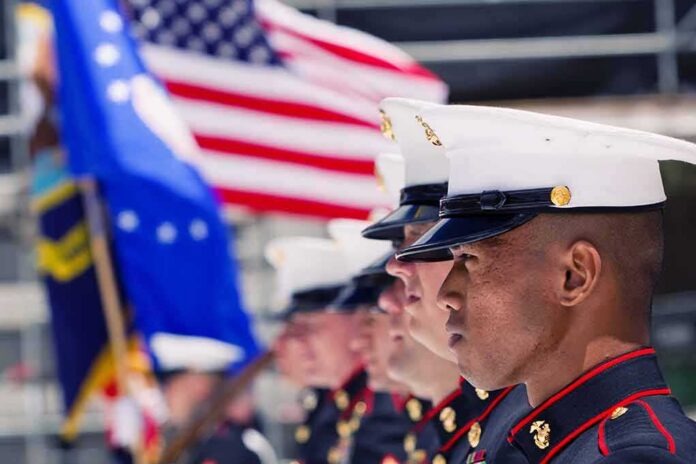
After three years of alarming shortfalls that raised genuine questions about America’s ability to man its armed forces, the U.S. military has executed one of the most significant recruiting turnarounds in a generation — and the numbers are specific enough to demand attention from anyone who cares about national defense.
At a Glance
- All five active-duty services met or exceeded their FY2025 recruiting goals, collectively achieving 103% of the combined accession mission — the strongest performance in 15 years.
- The Navy led the surge in percentage terms, exceeding its target by more than 8%; the Army signed 62,050 recruits against a goal of 61,000.
- The momentum is carrying into FY2026: the Army met its full-year active-duty goal roughly four months before the fiscal year’s close.
- The rebound is real, but context matters — it follows catastrophic shortfalls in FY2022 and FY2023, and reserve components, particularly the Army Reserve, still lag behind.
- No single cause explains the turnaround; the recovery began under the prior administration and accelerated through a combination of structural program reforms, incentive changes, and a shifting cultural climate around military service.
The Numbers Behind the Headline
The raw figures from the Department of Defense are unambiguous. In fiscal year 2025, the Army signed contracts with 62,050 recruits against a goal of 61,000 — 101.72% attainment. The Navy brought in 44,096 sailors, exceeding its target of 40,600 by more than 8%. The Air Force recruited 30,166 airmen, just clearing its goal of 30,100. The Space Force enlisted 819 Guardians against a target of 796. The Marine Corps hit its goal of 26,600 exactly. Taken together, the five active-duty services achieved a collective completion rate of 103% — a figure the Pentagon has not seen since roughly 2009.
The Coast Guard, administered by the Department of Homeland Security rather than the Pentagon during peacetime, added its own exclamation point: 121% of its 2025 recruiting goal. What makes these numbers striking is not merely that goals were met — active-duty services meeting goals was the norm through most of the 2016–2019 period — but that they were met after two consecutive years of severe shortfalls that left the Army, in particular, well below authorized strength. The Army missed its FY2022 goal by 25% and its FY2023 goal by 10%, representing tens of thousands of missing soldiers in a force that requires roughly 65,000 new accessions annually just to sustain itself.
How the Crisis Developed — and Why the Rebound Took Time
Understanding the FY2025 result requires understanding the hole from which the military climbed. The COVID-19 pandemic effectively shuttered in-person high school recruiting for the better part of two years, severing the relationship between recruiters and the pool of 17-to-24-year-olds who constitute the primary enlistment demographic. That structural disruption coincided with a historically tight civilian labor market: when unemployment is low and wages are rising, the military competes against private employers offering their own signing bonuses and career incentives. The Marine Corps and Space Force — smaller, more selective, with strong brand identity — consistently met their goals through this period; the Army and Navy bore the brunt of the shortfall.
The recovery did not begin on any single date or under any single administration. Pentagon data show that recruitment rose 12.5% in FY2024 compared to FY2022 levels, with nearly all services meeting their goals that year — a rebound that was already underway before the current administration took office. Major General Johnny Davis, commander of U.S. Army Recruiting Command, stated in October 2024 that the recruiting momentum “really started in February 2024, after about a year of putting many of these initiatives together.” The Army’s Future Soldier Preparatory Course, established in 2022, is one concrete example: a pre-enlistment program that addresses fitness and aptitude deficiencies before accession, with a reported 95% graduation rate. These structural investments take time to yield results, which is precisely why the FY2025 numbers reflect multi-year effort rather than any single policy lever.
What Actually Drives Enlistment — and What Doesn’t
Political figures on both sides have been quick to claim credit for the turnaround, and the temptation is understandable — recruiting success is a powerful symbol of national confidence and institutional trust. The evidence, however, supports a more complicated story. The upward trend predates the current administration’s policies by at least a year, rooted in program reforms, improved recruiter-to-prospect ratios, expanded eligibility criteria, and enhanced enlistment bonuses funded through a $6 billion investment in recruiting and retention over the preceding three years. None of that negates the possibility that a changed cultural climate around military service is contributing to the FY2025 surge; it simply means the causation is layered and cannot be reduced to any single variable.
What the evidence does not support is the claim that DEI policies caused the recruiting crisis or that their rollback caused the recovery. USAFacts data tracking entry-level enlistment trends show the decline began well before any DEI initiatives were implemented at scale, and the FY2024 rebound — which preceded most of the current administration’s policy changes — was driven by the same demographic cohorts that were supposedly deterred. The more durable structural pressure, one that no policy change can quickly resolve, is demographic: the U.S. birth rate has been declining for decades, and the pool of 17-to-24-year-olds eligible and qualified for military service is projected to shrink further. Physical fitness and educational qualification rates among American youth remain persistently low, which is precisely why programs like the Future Soldier Preparatory Course exist.
GOD BLESS OUR
MILITARY
GOD BLESS AMERICAWatching @FoxNews @AmericaNewsroom
interviewing two U S Thunderbird fighter pilots!
GOD BLESS THEM
Their parents must be
PROUD— GeorgiGirl (@TGLO1105) July 3, 2026
The Reserve Gap and the Readiness Question
One caveat deserves more than a footnote. While the active-duty picture is genuinely strong, the reserve component tells a more mixed story. Most reserve branches met their FY2025 goals — but the Army Reserve achieved only 75% of its target, continuing a pattern of reserve shortfalls that has persisted across multiple fiscal years. The Army Reserve and National Guard represent a substantial portion of total U.S. military capacity, particularly for logistics, civil affairs, and surge deployments; a sustained reserve shortfall is not a minor asterisk.
The readiness question extends further. Signing an enlistment contract is the beginning of a process, not the end of one. Military Times reporting on the FY2025 numbers noted that no standardized, publicly available department-wide metric exists for measuring how long it takes a new accession to become fully mission capable — a gap that matters enormously for force planning. Training timelines vary by specialty from a few months for administrative and support roles to several years for special operations and highly technical fields. A Navy official put it plainly: readiness “is not really time-based. It’s can you do the mission?” That answer is honest, but it also means a recruiting headline and a readiness assessment are measuring different things.
FY2026 and the Trajectory Ahead
The momentum from FY2025 has carried forward with unusual force. The Army announced it had met its full FY2026 active-duty recruiting goal — more than 61,500 contracts signed — roughly four months before the fiscal year’s end, a pace that suggests the structural improvements to the recruiting enterprise are holding. At the start of FY2026, the Pentagon reported that the department had already met nearly 40% of its delayed entry program accession mission, meaning recruits who have committed but not yet reported for training. That pipeline metric is the leading indicator recruiters watch most closely, and it points toward another strong year.
The longer-term challenge is structural rather than cyclical. The eligible youth population will contract. Competition from civilian employers for technically skilled workers — the precise profiles the military most needs — will intensify. And the costs of sustained recruiting success are real: the $6 billion invested over three years in recruiting and retention is not a one-time expenditure but a floor that must be maintained or exceeded. The FY2025 numbers are a genuine achievement, earned through years of program investment and recruiter effort. They are also a snapshot, not a solution to pressures that will require sustained institutional commitment to manage. The military has climbed out of a deep hole; the question now is whether it can stay on higher ground.
Sources:
facebook.com, washingtontimes.com, militarytimes.com, war.gov, instagram.com, pmc.ncbi.nlm.nih.gov, youtube.com, usamm.com, recruiting.army.mil
© bingeworthynews.com 2026. All rights reserved.