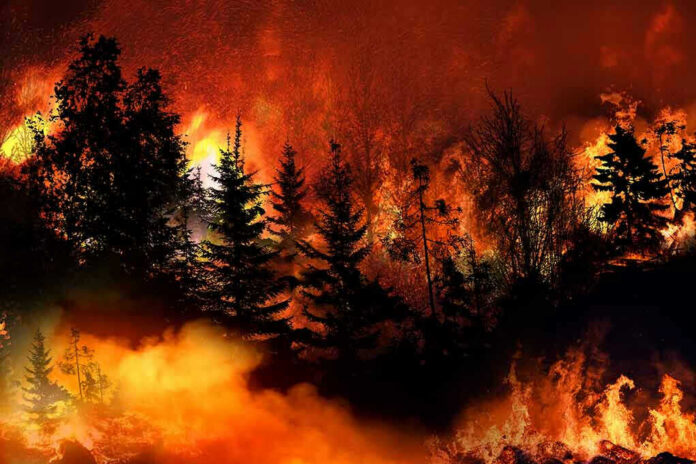
As nine fast-growing Colorado wildfires kill federal firefighters and force thousands from their homes, many residents see another sign that basic government promises of safety and preparedness are breaking down.
Story Snapshot
- Three federal wildland firefighters died in a burnover on the Snyder Fire near the Utah-Colorado border, highlighting serious strain on front-line crews.
- The Aspen Acres Fire exploded from about 2,500 acres to more than 23,000 acres in under a day, forcing mandatory evacuations for roughly 4,000 people.
- Nine active fires have already burned more than 84,000 acres across Colorado, with some major fires still listed at or near zero containment.
- Governor Jared Polis declared a disaster emergency and activated the National Guard, raising hard questions about long-term wildfire policy and community readiness.
Deadly Snyder Fire Exposes Risks for Front-Line Crews
Three federal wildland firefighters were killed and two others were injured when the Snyder Fire overran their position near the Utah-Colorado border. Officials say the crews were working on the Knowles and Gore fires when a fast-moving burnover cut off escape routes and forced them to deploy emergency fire shelters, a last-resort tactic that still could not save all of them. The merged Snyder Fire has burned tens of thousands of acres with little containment, showing how extreme heat, wind, and dry fuel can overwhelm even trained teams.
Reports describe blistering heat, powerful winds, and lightning strikes feeding multiple fires on the Western Slope and across the Four Corners region. The National Weather Service warned of “extreme fire behavior” and “critical” conditions, meaning fires can spread faster than crews can chase them. For many Americans, the loss of federal firefighters underscores a deeper fear: the people sent to protect communities are being asked to do more with the same tools while risks keep rising.
Aspen Acres Fire Explodes, Forcing Mass Evacuations
South of Pueblo, the Aspen Acres Fire grew from roughly 2,500 acres to more than 23,000 acres in less than a day, driven by wind and bone-dry grass and timber. Local reports say the fire was at zero percent containment when officials ordered mandatory evacuations for about 4,000 residents in and around Beulah, Rye, and San Isabel. At least four homes have already been destroyed, and more than 2,000 structures sit in the fire’s path, leaving families to grab what they can and flee.
County and state leaders are telling people to leave as soon as they receive an evacuation order, stressing that there may be only one safe road out of many mountain communities. Guides from Colorado counties urge residents to keep go-bags ready, know two routes out, and plan where to meet if phones fail, because once the flames are close there is no time left to prepare. These rules sound simple, but for older residents, people with disabilities, and working families, they reveal how much wildfire risk has shifted onto individuals instead of institutions.
Nine Wildfires, 84,000 Acres, and Worsening Smoke
Statewide, nine active wildfires have burned more than 84,000 acres across Colorado as of June 30, 2026. The Snyder Fire has consumed over 30,000 acres and was initially reported at zero containment, while southern Colorado fires like Aspen Acres and a large Custer County blaze near Rye also remain largely uncontained. Air quality has dropped sharply, with smoke pushing index levels above 100 in parts of the Front Range, a range the government itself labels “unhealthy” for sensitive groups.
Colorado wildfires destroy more than 100 structures, force more evacuations https://t.co/lCsanuWnQA pic.twitter.com/OMqDPuKLcO
— Canon City DR (@ccdr) July 1, 2026
Researchers at Colorado State University show that this emergency is part of a thirty-year pattern, not a freak one-time event. Their work finds that since 1990, Colorado wildfires have grown more frequent and much larger, with a few extreme fires now accounting for most of the burned land. Many residents on both the left and the right look at these numbers and ask why, after decades of warnings, communities still face the same weak protections year after year.
Preparedness Gaps and the Question of Trust
County wildfire guides urge families to sign up for alerts, plan escape routes, and prepare go-bags with food, medicine, and key papers. They explain how to evacuate pets and livestock, what to do if trapped at home or in a car, and how to safely return after the flames pass. These instructions are practical and needed, but they also highlight a hard truth: when fire hits, survival often depends on what ordinary people did weeks or months earlier, not on last-minute help from distant agencies.
Many conservatives see these fires as proof that years of focus on global talking points and bureaucracy have not fixed basic problems like forest fuel loads and grid resilience. Many liberals see the same scene and argue that shrinking social programs and emergency budgets leaves working families exposed while the wealthy can rebuild elsewhere. Both sides increasingly share one belief: the “deep state” and political class talk about climate and safety, but leave regular people to face the flames and the bills when disaster hits.
Extreme Fires and a Strained System
Fire maps and official briefings show firefighters racing to protect neighborhoods while struggling with steep terrain, strong winds, and limited air support. Federal, state, and local crews are working together, yet the spread of nine major fires at once stretches resources thin and forces tough choices about which communities get help first. For many evacuees, sleeping in gyms or with relatives, this raises a deeper worry: in the next big fire, will help arrive in time, or will government systems simply be overwhelmed again.
Experts say more extreme fires are “inevitable” and urge residents to get “live wildfire ready” with better home defenses, defensible space, and evacuation practice. Those steps can save lives, but they cannot replace broader work on land management, power infrastructure, and honest accountability when warnings go unheeded. As Colorado mourns three fallen federal firefighters and counts the acres still burning, many Americans see not only a natural disaster, but another warning that a stressed and divided government is failing a core test: keeping people safe in their own homes.
Sources:
youtube.com, denvergazette.com, coloradosun.com, facebook.com, en.wikipedia.org, propertyinsurancecoveragelaw.com, wildfirepartners.org, instagram.com, co-pub.coloradoforestatlas.org, hazards.colorado.edu, jeffco.us
© bingeworthynews.com 2026. All rights reserved.