A naked man’s 278-foot leap from the Brooklyn Bridge — and his shocking survival — is raising hard questions about public safety, mental health, and a government that seems better at reacting to crises than preventing them.
Story Snapshot
- A 44-year-old man, identified as Galymzhan Abaildayev, climbed the Brooklyn Bridge’s north tower, stripped naked, and jumped into the East River, yet survived and was rescued in stable condition.
- Police say he affixed flags at the top of the bridge and may have held a makeshift parachute-like item above his head as he leapt, turning the jump into a public spectacle caught on video.
- New York City police arrested him and say he faces multiple charges, including reckless endangerment, making graffiti, public lewdness, criminal trespass, and disorderly conduct.
- Experts note that a fall from about 278 feet is usually fatal, suggesting his survival depended on body position, luck, and rapid rescue — yet the event also highlights deeper failures in mental health care and public trust.
A dramatic leap that shocked New York City
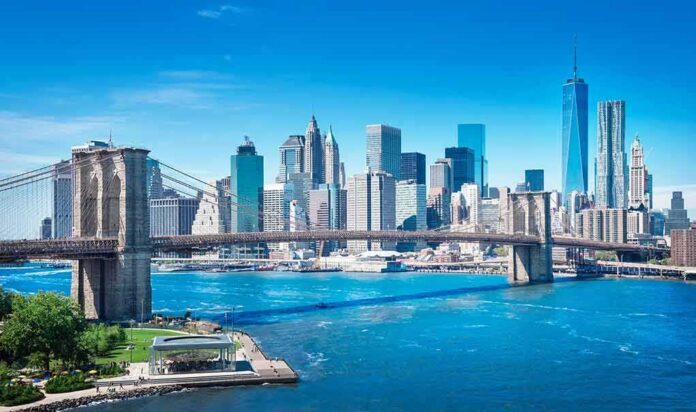
On a Sunday afternoon in early August, New York City residents watched in shock as a naked man climbed the Brooklyn Bridge’s north tower on the Manhattan side, attached flags, stripped off his clothes, and jumped into the East River. Police and witnesses say the man, later identified as 44-year-old Galymzhan Abaildayev, made the leap from near the top of the tower, a drop reported at roughly 278 feet. Video of the jump spread online within hours, turning a frightening moment into viral content.
New York City Police Department officers from an emergency services unit tried to climb the tower and talk him down before he jumped. As he fell, several clips show him holding an item above his head, which some outlets described as a “makeshift parachute,” though experts say there is no clear proof it slowed his fall in a major way. After he hit the water, the police harbor unit quickly reached him, pulled him from the river, and took him to Bellevue Hospital, where he was listed in stable condition.
From rescue to criminal charges and unanswered motives
Once doctors confirmed that Abaildayev had survived the plunge, police moved from rescue mode to legal response. According to New York City Police Department statements quoted by major outlets, he now faces charges including reckless endangerment, making graffiti, public lewdness, criminal trespass, and disorderly conduct. Those charges reflect both the danger he posed to himself and to people below, and the damage or defacement tied to the flags and markings he placed on the bridge.
Reports describe Abaildayev as a Kazakhstan activist who had talked about making the jump on his birthday, suggesting there may have been a political or personal message behind his actions. A roommate told one outlet that he had “plotted” the leap in advance, but full details of his motive, mental state, and any statement he intended to send are still not clear from public records. This gap leaves citizens guessing, as sensational headlines focus on the “naked nutjob” angle instead of deeper questions about why someone would risk such an extreme act on a public landmark.
A rare survival that exposes deeper system failures
Medical experts told reporters that a fall from a bridge tower height — around 270 to 278 feet — is usually “overwhelmingly fatal,” with common results including broken bones, spinal injury, and severe internal damage. One trauma specialist said the main reason Abaildayev may have lived was the way his body hit the water, with a feet-first or streamlined posture helping cut the damage. Quick rescue and fast hospital care also mattered; without them, even a survivable impact could have turned deadly within minutes.
The surprising reason why Brooklyn Bridge jumper may have survived 'overwhelmingly fatal' plunge https://t.co/Ijov8SnQbd
— Churlish Insubordinate (@sparklecopy) August 4, 2026
For many Americans, the story lands differently than the breathless headlines suggest. Some see a failure of mental health support, asking how a man could reach such a crisis point in the first place without help. Others worry about basic public safety and infrastructure: if someone can scale a major bridge, plant flags, and jump in full view of traffic and tourists, what else could slip through the cracks. Both left and right share a growing sense that leaders talk about “safety” and “care,” yet real help arrives only after a disaster — if it arrives at all.
Risk, spectacle, and a government people no longer trust
Brooklyn Bridge jumps are not new; historians note earlier claimed leaps, including the famous case of Steve Brodie in the 1800s. Police today say that a few people still try to jump from the bridge every year, and some survive. But the modern twist is the role of social media and nonstop news, which turn each crisis into a spectacle, often before official records are public and facts are nailed down. Clips of Abaildayev’s jump raced across platforms, while details about his mental health and motive remained sketchy.
This pattern feeds a wider frustration among Americans. Many on the right see a city that cannot secure its own landmarks and a system that reacts but cannot prevent chaos. Many on the left see someone in deep distress whose main contact with the state came through police, criminal charges, and tabloid mockery rather than steady support. Both groups look at an event like this and feel the same thing: a government focused on managing headlines and liability more than fixing root problems. The naked leap off the Brooklyn Bridge is shocking, but for many, the deeper shock is how familiar that failure now feels.
Sources:
facebook.com, ndtv.com, nbcnews.com, yahoo.com, abc7ny.com, instagram.com
© bingeworthynews.com 2026. All rights reserved.