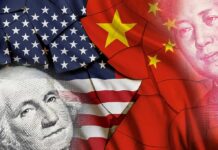
President Trump heads to China amid high-stakes talks on trade and Iran, but analysts warn Beijing holds the upper hand in negotiations that could weaken America’s leverage.[1][4]
Story Highlights
- Trump’s state visit to China set for May 13-15 at Xi Jinping’s invitation, first since 2017, postponed from March to prioritize Iran war.[3]
- Discussions target Iran peace efforts, Strait of Hormuz reopening, and trade truce extension involving tariffs, rare earths, and U.S. agriculture.[4][5][7]
- Prior Busan meeting cut tariffs from 57% to 47%; Trump thanked China for Iran ceasefire support, yet peace efforts falter.[5][6][7]
- Minimal preparation raises risks; think tanks like CFR predict modest outcomes with China leveraging Taiwan and tech exports.[1][4][7]
- Conservatives watch warily as personal diplomacy tests Trump’s America First strategy against China’s global ambitions.[1][2]
Visit Details and Historical Context
Chinese Foreign Ministry spokesperson announced on May 11 that President Donald Trump will pay a state visit to China from May 13 to 15 at the invitation of President Xi Jinping. This marks the first U.S. presidential visit to China since 2017 and Trump’s initial trip in his second term.[3] The White House detailed pomp including a Temple of Heaven tour and state banquet.[3] Originally planned for late March or early April, Trump postponed to focus on the Iran war.[3] Beijing confirmed the dates via Xinhua, aligning with U.S. officials’ expectations for Iran and trade discussions.[1]
Trump travels with First Lady Melania for the two-day event in Beijing, amid ongoing U.S.-China tensions over tariffs, Middle East conflicts, and Taiwan.[2][3] Historical patterns show U.S.-China summits often promise breakthroughs but deliver modest steps, with only 25% yielding long-term tariff reductions per Council on Foreign Relations data.[2][7] This “summit hype cycle” recurs despite 12 major engagements since 2017.[2]
Prior Diplomatic Wins and Trade Progress
Trump and Xi met in Busan, South Korea, on October 30, 2025, reducing U.S. tariffs on Chinese imports from 57% to 47%.[5] Trump rated the summit “12 out of 10,” highlighting progress.[5] Six to seven rounds of economic talks between Chinese Vice Premier Hu Chunhua and U.S. officials, including Secretary Wilbur Ross and Ambassador Robert Lighthizer, advanced market access for U.S. beef, soybeans, and Boeing planes.[7] Trump thanked China for supporting Iran’s path to negotiations, enabling a two-week ceasefire announced weeks earlier.[7]
Expectations include extending the trade truce: China exports rare earths and buys U.S. agricultural products in exchange for partial tariff relief.[7] Trump seeks Chinese backing for an Iran agreement to end the conflict and reopen the Strait of Hormuz, proposing a “board of trade” and “board of investment.”[4][7] Preparatory talks occurred in Seoul days before the summit.
Risks and Analyst Warnings
Preparation remains minimal with few back-channel negotiations, prompting Chinese concerns over spontaneity and U.S. policy coherence.[7] Trump called Iran’s peace response “totally unacceptable,” signaling faltering efforts despite prior Chinese attribution.[6] No binding pre-visit commitments exist for tariff extensions or Hormuz reopening; outcomes rely on projections.[1][4][7]
US President Donald Trump to visit China from May 13 to 15
At the invitation of Chinese President Xi Jinping, US President Donald Trump will pay a state visit to China from May 13 to 15, a Chinese foreign ministry spokesperson announced on Monday.#XiJinping #Trump #ChinaUS… pic.twitter.com/Z5sM3ESNQc
— CGTN Europe (@CGTNEurope) May 11, 2026
Council on Foreign Relations experts like Rush Doshi and Chris McGuire argue China holds the upper hand, leveraging Taiwan and criticizing U.S. relaxed export controls on tech like AI chips.[1][7] Chinese state media frames the U.S. Iran actions as aggression, while providing Iran surveillance tech.[7] Critics decry reliance on personal Trump-Xi rapport as short-term without long-term strategy, risking concessions on Taiwan policy.[1][7] Brookings and CSIS predict only modest steps forward.[4]
Sources:
[1] At the Trump-Xi Summit, China Will Have the Upper Hand
[2] 2026 state visit by Donald Trump to China – Wikipedia
[3] This is how U.S. President Travels to China – YouTube
[4] Trump-Xi Summit in Beijing: Managing the World’s Most Important …
[5] US-China relations: What to expect from the Trump-Xi summit
[6] Iran Peace Efforts Falter & China Confirms Trump-Xi Summit
[7] Five things to watch as Trump goes to Beijing – Brookings Institution