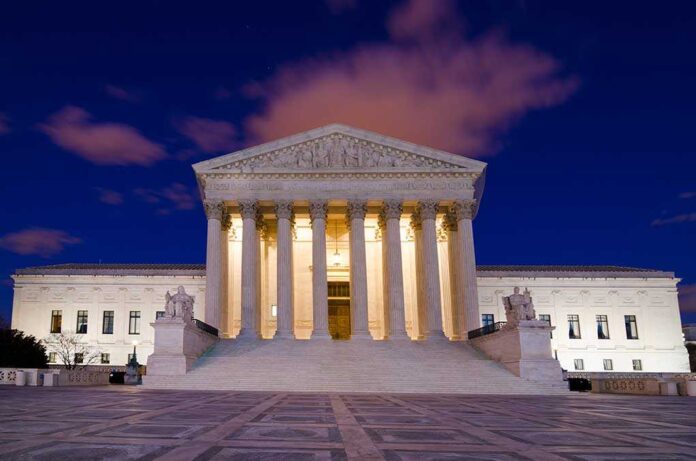
As the Supreme Court wrestles with when a criminal is too mentally disabled to execute, conservatives see a legal gray zone that risks turning justice into a feelings-based guessing game instead of a rule-of-law standard.
Story Snapshot
- The Supreme Court is struggling to define when mental disability should bar the death penalty, exposing deep uncertainty in current law.
- Justices are debating whether objective IQ tests or vague, subjective standards should control life-or-death decisions.
- Loose definitions risk shielding dangerous criminals while sidelining victims’ families and public safety.
- Conservatives worry that activist interpretations could erode clear sentencing laws passed by elected legislators.
Supreme Court Confronts Confusion Over Mental Disability and Execution
The Supreme Court recently heard arguments in a death penalty case that forced the justices to confront a difficult question: when is someone too mentally disabled to face execution for brutal crimes? The Court’s discussion centered on how to measure intellectual disability in a way that is fair but also consistent with the Constitution and prior precedents. Justices questioned whether hard-number IQ test cutoffs or more flexible, subjective assessments should guide decisions about who can be executed.
During the hearing, some justices pressed attorneys on the reliability of IQ scores, noting that tests can vary over time and across examiners, especially near borderline ranges. Others highlighted the danger of relying heavily on open-ended “clinical judgment,” which can invite bias, political pressure, or activism masked as science. The central concern was how courts can apply a nationwide standard that respects the Eighth Amendment while avoiding arbitrary, case-by-case exceptions that undermine consistent punishment.
Objective Standards Versus Subjective Yardsticks
The debate exposed a sharp tension between those favoring clear, objective benchmarks and those pushing for broad judicial discretion. IQ tests, while imperfect, offer concrete numbers that trial courts and juries can apply the same way in every case. Supporters of that approach argue that the justice system needs predictable rules, especially in capital cases, so similar offenders receive similar treatment rather than wildly different outcomes based on which judge they draw.
Critics of strict IQ thresholds urged the Court to allow more weight for adaptive functioning, expert testimony, and social context, claiming that intelligence is too complex to be reduced to a single score. That approach, however, risks turning death penalty eligibility into a moving target. When courts rely heavily on subjective impressions, defendants with comparable histories and crimes may be treated very differently, which erodes public confidence. Conservatives worry that such vagueness becomes a backdoor way to chip away at capital punishment without elected lawmakers ever voting to end it.
Implications for Justice, Victims, and Public Safety
How the Court rules will shape not only this case but future challenges from death row inmates seeking to avoid execution by claiming mental disability. If the justices embrace broad, flexible standards with minimal objective guardrails, states could see a wave of new appeals arguing that existing sentences are unconstitutional. That would prolong cases for years, delay closure for victims’ families, and strain state resources already stretched by endless litigation and appeals processes.
On the other hand, a decision emphasizing measurable criteria like IQ ranges, corroborated by consistent medical documentation, would signal that the Court expects disciplined, evidence-based evaluations rather than open-ended speculation. Such an outcome would still protect truly intellectually disabled individuals, while preventing the label from being stretched so far that it becomes a routine escape hatch. For many conservatives, the key is preserving a punishment framework that is both humane and firm enough to deter the worst crimes.
Conservative Concerns About Judicial Overreach and the Rule of Law
For a conservative, Trump-era audience tired of activist courts, this case raises familiar alarms about unelected judges effectively rewriting criminal law from the bench. State legislatures have already updated their statutes to comply with prior Supreme Court rulings that forbid executing individuals with genuine intellectual disabilities. When justices now debate whether to lean more heavily on “subjective yardsticks,” it sounds like an invitation for future courts to keep moving the goalposts away from what lawmakers actually enacted.
Many on the right see a broader pattern: whenever a legal issue touches capital punishment, law and order, or victims’ rights, the pressure tends to favor expanding protections for offenders while narrowing tools for prosecutors and juries. If the final ruling blurs standards instead of clarifying them, it could embolden lower courts and advocacy groups to push further limits on the death penalty. That, in turn, may weaken the system’s ability to deliver firm consequences for the most heinous acts, from child murders to terror-style mass killings.
Sources: