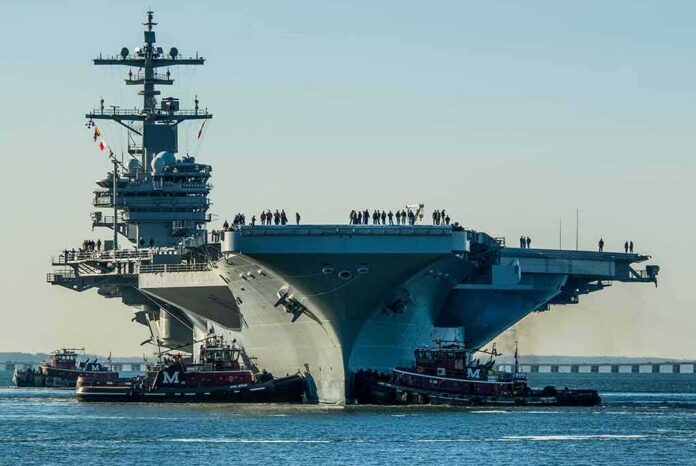
After 265 straight days without a port call, the USS Abraham Lincoln finally steamed into San Diego and thousands of sailors ran into waiting arms.
Story Highlights
- The carrier returned to San Diego after more than 10 months at sea, ending an unusually long deployment.
- The crew spent a record 265 consecutive days at sea without a port visit, a modern Navy milestone.
- The mission supported operations tied to the Iran war and the broader Middle East.
- Navy leaders acknowledged heavy strain on the crew, including eight suicide attempts during the deployment.
Carrier Returns After One of the Longest Modern Deployments
Associated Press and National Public Radio reported the USS Abraham Lincoln returned to San Diego Bay after more than 10 months at sea, marking one of the longest carrier deployments since the Cold War. ABC News and the Orange County Register placed the total length near 321 to 322 days, making it the second-longest post-Cold War deployment by this measure. Reports consistently tied the mission to extended operations in the Middle East linked to the Iran war before the homecoming.
Multiple outlets reported the crew set a modern record with 265 straight days at sea without a port visit. That single metric stood out even as the overall deployment ranked near, but not at, the top of the post-Cold War list. Families lined the waterfront for emotional reunions, with new parents meeting babies born during the cruise and children seeing a parent for the first time in nearly a year, according to wire and broadcast coverage.
Leaders Cite Mission Demands and Crew Hardship
Defense coverage described senior officials greeting the ship near its return. Reports attributed to Defense Secretary Pete Hegseth noted he twice signed orders extending the deployment and told the crew he knew he stood between them and home. The acting Navy secretary acknowledged eight suicide attempts within the strike group during the mission, underscoring the toll of the long stretch at sea and the pace of operations, according to ABC News and local reporting.
Los Angeles Times reporting quoted a top combatant commander calling the cruise “one of the most operationally intense and consequential of the modern era,” reflecting the mission’s demands in contested waters. While some outlets described onboard strains such as supply and maintenance challenges, the available reports did not cite a single, comprehensive Navy document that summarized every condition or metric in one place. Still, the core facts of the return, the record sea streak, and the Middle East focus were consistent across major outlets.
What This Says About U.S. Navy Tempo and American Life
Security analysts have tracked a steady rise in deployment length and unpredictability since 2023. Research from the Royal United Services Institute stated that most recent carrier cruises ran eight months or longer, with several at nine months or more, putting the Lincoln’s tour inside a broader trend of fleet overstretch. That pattern reflects many pressures at once: global flashpoints, limited hulls to share the load, and leaders who extend ships to meet urgent tasks.
US Navy's USS Abraham Lincoln Returns to San Diego After Record-Breaking 10-Month Deployment at Sea
Watch: https://t.co/Saa9zSBza8 pic.twitter.com/nKXuqCtsJo— India Today Global (@ITGGlobal) October 9, 2026
For Americans watching from the pier, the math is simple and human. Long deployments test marriages, burden single parents, and pull moms and dads from newborns. The homecoming showed joy and pride, yet also the cost of keeping a carrier on station for most of a year. People across the political spectrum can see both truths at once: the mission mattered, and the price was real for sailors and families who did their duty while Washington debates resources and priorities.
Sources:
zerohedge.com, apnews.com, ocregister.com, fox35orlando.com, irishnews.com, newsnationnow.com, nbcconnecticut.com, crow.house.gov
© bingeworthynews.com 2026. All rights reserved.