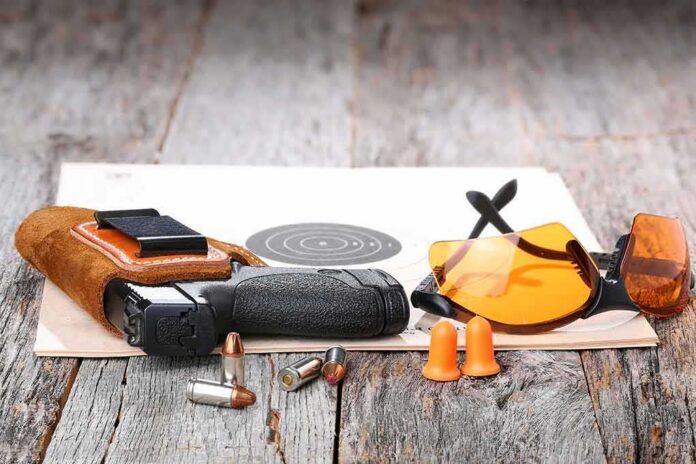
The Glock 44 works precisely when you treat it as what Glock built it to be: a rimfire, G19-sized trainer that lowers cost and recoil to sharpen fundamentals—useful for building skill, not a substitute for a centerfire defensive carry pistol.
The Short Version
- The G44 mirrors Glock 19 ergonomics and holster fit, making practice highly transferable for Glock users.
- .22 LR, a hybrid steel-polymer slide, and very light weight mean minimal recoil and low-cost reps—ideal for fundamentals and new shooters.
- Reliability is best with quality, higher-velocity rimfire loads; bulk or underpowered ammo can induce stoppages.
- Glock positions the G44 as a training platform, not a defensive-carry gun; rimfire ballistics and variability keep it in the trainer lane.
What the G44 Is For: A Trainer That Feels Like a G19
Glock built the G44 around a simple concept: give Glock 19 owners a rimfire pistol that matches their grip, sights, and presentation, so the motor patterns they groove at low cost carry over to their centerfire sidearm. The European technology documentation explicitly ties the G44’s short-frame dimensions to the Gen5 G19, which is why slide indexing, sight picture, and holster fit are so familiar. That geometry matters. Draw strokes, trigger prep, sight tracking, and recoil control are all context dependent; practicing them on a lookalike platform preserves context better than switching to an unrelated.22.
Mechanically, the G44 is a blowback.22 LR with a hybrid steel-polymer slide—light enough to cycle on rimfire energy, robust enough to maintain Glock’s form factor. The pistol ships featherweight by Glock standards—12.63 ounces unloaded—which, combined with.22 LR, yields very low recoil and minimal muzzle flip. For new shooters and for high-volume skills practice, that means more learning per dollar and less flinch-building per session.
Why Rimfire Makes Sense for Reps—and Where It Doesn’t
Rimfire’s value proposition is straightforward: inexpensive ammunition and soft recoil enable the volume needed to refine mechanics—grip pressure, front-sight discipline, trigger isolation—without fatigue or cost blowback. The G44 adds Glock’s Marksman Barrel and adjustable sights, which make it easier to test and verify your fundamentals at 15–25 yards rather than merely plink at seven. For instructors, the easy-to-rack slide and low report are a boon when onboarding new shooters or diagnosing trigger control errors without the distraction of 9mm recoil.
But rimfire also has well-known constraints. The priming compound is spun into the rim, not seated in a discrete primer cup; ignition variability and limited recoil impulse are inherent to the cartridge, and that translates into platform behavior. Across credible hands-on reviews, the G44 runs best with quality, higher-velocity loads, while bulk and match subsonics can produce stovepipes or failures to cycle—a predictable pattern for.22 self-loaders that no brand fully escapes. That doesn’t undercut the training mission; it delineates it. Choose reliable ammunition for your practice pistol the same way you would for a match gun, and log stoppages like a professional.
Dimensions, Controls, and Holster Compatibility Drive Skill Transfer
Most of what shooters informally call “transfer” is neuromuscular memory reinforced by identical ergonomics and controls. The G44’s G19-sized frame, familiar trigger reach, magazine release location, and sight radius keep those cues intact, which is why dry and live reps feel the same in the hand. Glock’s own materials position the G44 in the training category, not as a duty or defensive analog, but the dimensional match to a G19 Gen5 is deliberate—it’s the bridge that lets a shooter accumulate live-fire data on sight lift, reset cadence, and follow-through without burning centerfire ammo budgets.
Capacity has also matured. The pistol launched with 10-round magazines, which sufficed for basic drills but limited string length. Glock’s current U.S. page lists a 15-round capacity, and third-party testers have exercised OEM 15-rounders, improving drill design and reducing reload frequency during practice blocks. The tactical takeaway is logistical, not tactical: more rounds per magazine streamline training flow, not carry doctrine.
Training Use Cases That Exploit the G44’s Strengths
– Accuracy ladders: five-round groups at 15 and 25 yards with the same cadence you run on a G19, diagnosing grip torque and trigger press without recoil masking errors.
– Cadence control: metronome-paced doubles and triples, watching the front sight’s return-to-zero; the lighter slide amplifies visual feedback on grip consistency.
– Presentation and first-shot break: shot timer from concealment or duty holster, where identical holster fit anchors index and garment clear mechanics to a familiar frame.
– Malfunction management: induced stoppage drills with high-velocity ammo to minimize cartridge-induced noise, focusing on economy of motion with Glock-pattern controls.
Why It’s a Trainer, Not a Carry Gun
Two separable issues keep the G44 in the training lane. First, Glock’s own product taxonomy labels this a training pistol; its institutional framing is about skill development, not defensive deployment. Second, the cartridge..22 LR offers minimal recoil and cost but lacks the terminal performance and ignition consistency of service calibers. The research corpus here does not provide duty-validation, law-enforcement adoption evidence, or terminal ballistics demonstrating centerfire-equivalent performance; what we do have are platform specs and a broad review record that characterizes the G44 as reliable with the right loads, but still classically rimfire in its variability. Those facts align with the common-sense boundary many experienced shooters draw: train with rimfire, carry centerfire.
That boundary is not a knock on the G44; it is recognition of roles. The pistol succeeds when evaluated on training metrics—repetition, ergonomics match, and recoil economy—and is miscast when graded on duty metrics it was never built to meet. If your objective is defensive carry, a G19 or comparable 9mm remains the standard. If your objective is to shoot more, better, for less, a G19-sized.22 that rides your existing holsters is a rational, evidence-backed tool.
Buying and Setup Guidance
Configure the G44 to mirror your G19 where possible: sight picture, grip texture, and holster. Test ammunition across several high-velocity SKUs and lot numbers, then standardize on the load that cycles cleanly in your sample. Keep a simple log of stoppages by brand and lot; rimfire benefits from that discipline. If 15-round OEM magazines are available in your jurisdiction, adopt them for sustained drills; otherwise, build reloads into your practice to preserve cadence. The goal is frictionless transfer: the less your hands notice between pistols, the more your brain can focus on skill.
Sources:
19fortyfive.com, us.glock.com, americanfirearms.org
© bingeworthynews.com 2026. All rights reserved.