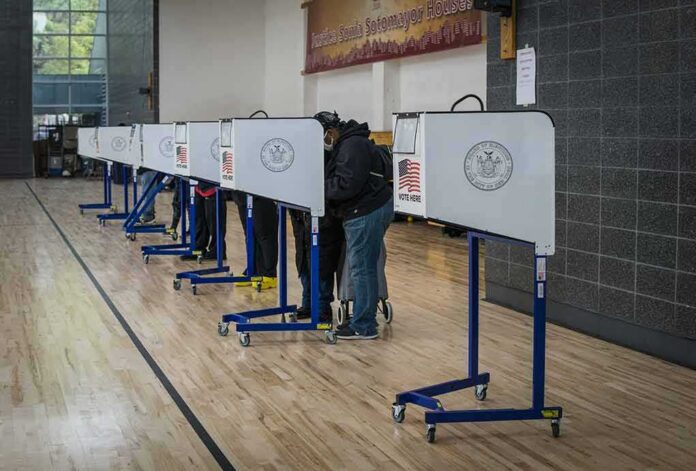
Democrats are defending a voter suppression message that clashes with their own voters, and the numbers are hard to ignore.
Quick Take
- Polling shows broad support for photo ID voting rules, including strong support from Democrats.
- Republicans are using that support to frame voter ID as common sense, not a radical change.
- Some voting-rights groups still warn that strict ID and citizenship rules can burden eligible voters.
- Many states already require some form of identification, which makes the debate more about how strict the rule should be.
Voter ID Now Has a Public Backing Problem
Democratic leaders often describe voter ID laws as suppression, but their own voters keep undercutting that claim. Pew Research found that 83 percent of Americans support requiring photo identification to vote, including 71 percent of Democrats. Other reporting summarized similar results from CNN-linked and White House-backed polling, which showed major support across racial groups and party lines.
That gap matters because the party’s public argument is no longer backed by public opinion. Republican officials are pressing the point that voter ID is a basic safeguard, not an extreme demand, and they cite the same polling to say the policy is already mainstream. Supporters also note that common forms of ID include driver’s licenses, state IDs, passports, military IDs, and tribal IDs.
Why Supporters Say the Rule Is Reasonable
Supporters of voter ID say the policy fits how Americans already prove who they are in daily life. The National Conference of State Legislatures reports that 36 states have some form of voter ID law, which makes identification checks a normal part of election administration rather than a brand-new idea. That point gives Republicans a simple message: voting should not be easier to verify than buying a flight or picking up a prescription.
Republicans also argue that broad ID lists weaken the claim that these laws are designed to shut people out. Senate GOP materials on the SAVE America Act say acceptable documents can include an unexpired driver’s license, a state ID, a passport, a military or veteran ID, or a tribal ID. In that framing, the rule is about proving identity and protecting trust in the vote, not about excluding lawful voters.
The Burden Argument Has Not Disappeared
Even with strong public support, the burden argument is not imaginary. Election-law critics say the hard part is not whether photo ID sounds fair, but whether every eligible voter can get the right papers in time. The Brennan Center warns that strict voter ID rules can require narrow documents that many eligible Americans do not have, and it points to large gaps in document access.
Why Democrats should support the SAVE America Act
You care about clean elections and public confidence. So do the majority of American voters, including large majorities of Democrats in poll after poll who support requiring citizenship verification and photo ID. The current…
— QuixoticMoose (@QuixoticMoose) July 23, 2026
That concern gets sharper when states or Congress add proof-of-citizenship rules on top of photo ID. The Bipartisan Policy Center says the SAVE America Act would require documentary proof of citizenship at registration and photo ID at voting, which raises the paperwork bar for voters who do not already have a passport or birth certificate ready. Critics say that is where a simple security check can become a real obstacle.
What the Debate Really Shows
The fight over voter ID is no longer just about fraud claims versus suppression claims. It is now a test of whether Democrats can keep using a message that many of their own voters do not buy. At the same time, the strongest conservative case is not that every ID rule is harmless, but that a clear, uniform standard is easier for voters to understand and harder to politicize.
That is why this debate keeps resurfacing. Supporters see a modest integrity rule that most Americans accept. Opponents see a system that can hit some voters harder than others. Both views still shape the fight, but the polling shows one thing clearly: the old slogan that voter ID is broadly unpopular no longer holds up.
Sources:
washingtontimes.com, nypost.com, studentnewsdaily.com, ballotpedia.org, republicanleader.senate.gov, nbcnews.com, ncsl.org, facebook.com
© bingeworthynews.com 2026. All rights reserved.