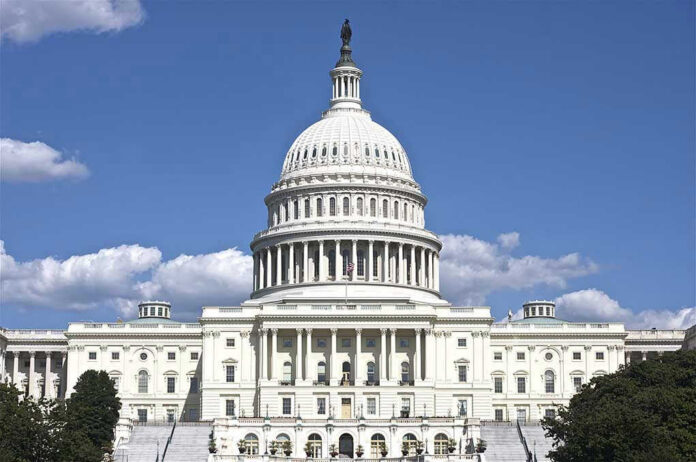
Congress only cleans its own house when the stench threatens everyone’s re-election.
Quick Take
- A rare bipartisan push is forming to expel multiple House members under an unusually high constitutional bar: a two-thirds vote.
- Rep. Anna Paulina Luna aims to force an expulsion vote on Rep. Eric Swalwell as Democrats prepare a counter-vote targeting Rep. Tony Gonzales.
- The strategy hinges on “paired” votes to blunt claims of partisan retaliation and to make accountability feel symmetrical.
- Additional lawmakers, including Reps. Cory Mills and Sheila Cherfilus-McCormick, could face a follow-on “cascade” if momentum holds.
The New Playbook: Pair the Targets, Then Dare the House to Blink
Rep. Anna Paulina Luna’s move to force an expulsion vote on Rep. Eric Swalwell did more than single out a Democrat facing serious allegations. It set a trap for both parties: either prove Congress can discipline itself, or confirm what voters already suspect. Democrats signaled they would answer with an expulsion push aimed at Rep. Tony Gonzales, turning the coming week into a paired test of credibility, not just conduct.
The constitution gives the House the power to expel, but it demands a supermajority so the tool can’t be used casually. That two-thirds requirement is why expulsion almost never happens, and why the “pairing” idea matters. If both parties publicly agree that one of theirs deserves discipline too, the vote stops looking like a purge and starts looking like a reset. That framing is the entire point.
Why Expulsion Is Rare: The Two-Thirds Wall and Leadership’s Quiet Veto
The House doesn’t need an outside court to expel a member, but it does need something harder: overwhelming political agreement. Two-thirds of the chamber means a coalition big enough to survive cable news, activist pressure, and the next primary. Leadership also controls time and attention, and silence can function like a veto. Speaker-level neutrality keeps members from feeling “whipped” into a risky vote, which is exactly why floor action often dies in procedural fog.
Recent history shows the pattern: scandals linger, investigations crawl, and voters watch consequences fail to materialize. That’s why the 2023 expulsion of George Santos still looms over this story as a modern exception, not a new norm. Members remember how long it took, how damning the underlying record was, and how high the political temperature ran. Anyone promising swift expulsions now must still clear the same wall: proof plus votes.
The Allegations and the Denials: What’s Driving the Pressure
Swalwell faces new allegations from multiple women involving sexual assault, harassment, and rape, which he has denied. The political damage already showed up in a clean, brutal metric: endorsers bolting from his California governor effort. Gonzales admitted to an affair with a staffer who later died by suicide, ended his reelection bid, and still did not resign, as an ethics investigation proceeds. Those facts create a combustible mix of grief, judgment, and public distrust.
Reps. Cory Mills and Sheila Cherfilus-McCormick hover nearby like the next dominoes. Mills faces a House Ethics probe tied to campaign finance issues and sexual misconduct accusations, which he denies. Cherfilus-McCormick has faced accusations involving misuse of pandemic-related funds, which she denies. None of these situations sits comfortably inside the usual “wait for the committee” posture. That bottleneck—scandal without consequence—has become the accelerant for this moment.
The Real Story Is the Incentives: A Narrow Majority and a Midterm Clock
Politics, not morality, usually determines whether Congress polices itself. The 119th Congress operates under narrow margins, and every potential expulsion threatens the math of control, the committee ratios, and the calendar of special elections. That reality explains why lawmakers talk about accountability while quietly measuring risk. Pairing votes attempts to reduce that risk by giving both parties a talking point: “We didn’t just go after yours; we cleaned our own too.”
American conservative values and common sense say accountability should not depend on party label, and resignations should beat drawn-out melodrama when credible evidence piles up. At the same time, conservatives should distrust any mechanism that can be weaponized as a routine political tool. The two-thirds threshold exists for that reason. If members treat expulsion like a headline generator rather than a last resort, they will cheapen the standard and invite tit-for-tat retaliation.
What Happens Next: The Parliamentarian, the Floor, and the Vote Count Nobody Admits
The immediate question is procedural: whether the parliamentarian allows the kind of paired approach Luna has discussed and how quickly leadership permits the question to hit the floor. Then comes the harder question: can anyone actually count to two-thirds? Experts have openly suggested an expulsion at this stage would be stunning. That skepticism deserves respect because it reflects institutional gravity, not sympathy for misconduct. The House rarely convicts its own unless the case becomes politically indefensible.
If this effort fails, voters will file it under “another Washington moment” and move on—until the next scandal. If it succeeds, the House will have tested a modern model: bipartisan symmetry as the price of accountability. Either outcome will echo into the midterms because it touches the one issue Americans across ideologies recognize instantly: rules for them, rules for us. This week’s votes, if they happen, will show which side Congress is on.
Sources:
Momentum Grows for Expulsion of Multiple Scandal-Ridden House Lawmakers
Eric Swalwell scandal: House expulsion votes
Swalwell, Gonzales, Cherfilus-McCormick, Mills expel
US Congress members facing expulsion amid sexual misconduct accusations