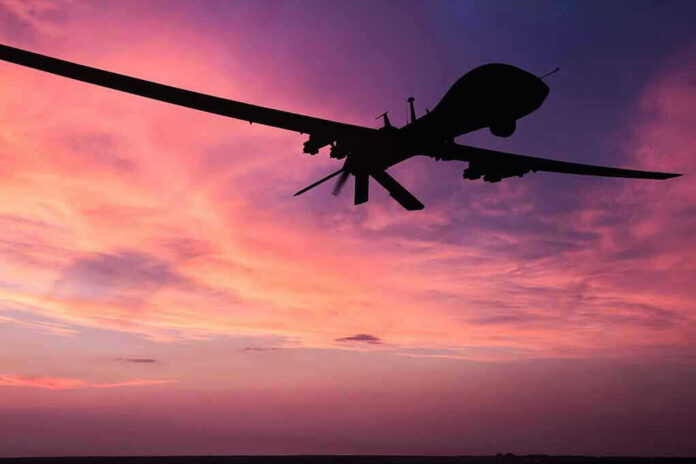
bingeworthynews.com — U.S. forces struck an Iranian Revolutionary Guard drone site and downed multiple attack drones near the Strait of Hormuz, signaling a harder line against Tehran’s provocations and a clear message: American ships and troops will be defended decisively.
Story Highlights
- U.S. Central Command reported self-defense strikes targeting an Iranian drone-control or launch site and intercepting attack drones [12][11].
- Iran’s Islamic Revolutionary Guard Corps claimed it shot down a U.S. MQ-9 and warned of “legitimate and decisive” retaliation [1][8][10].
- Conflicting claims mirror past U.S.–Iran incidents where facts emerge slowly and narratives harden early [4].
- Maritime security in the Strait of Hormuz—and stable energy prices—hinge on deterring Iranian attacks on shipping [12].
What CENTCOM Says Happened And Why It Matters
U.S. Central Command described recent actions as self-defense strikes intended to protect American troops and commercial shipping from imminent Iranian threats near the Strait of Hormuz. Reporting tied to the announcement stated that U.S. forces shot down four Iranian one-way attack drones and struck a ground facility connected to drone operations near Bandar Abbas, disrupting an additional launch [11][12]. The command’s framing emphasizes duty to safeguard U.S. sailors and merchant vessels, a core obligation when hostile actors target international waterways [12].
American officials indicated the downed drones were a direct threat to a U.S. Navy vessel and a nearby commercial ship, placing the engagement squarely within a defensive posture under established rules of engagement [12]. The strike on a purported drone-control or launch site near Bandar Abbas was presented as necessary to prevent further launches in real time [12]. For conservatives who demand peace through strength, these steps reflect an overdue reset: credible deterrence, quick decision-making, and the protection of sea lanes that keep fuel and goods affordable for American families [12].
How Iran Is Framing The Clash
Iran’s Islamic Revolutionary Guard Corps issued a counter-narrative, claiming it shot down a U.S. MQ-9 over the Persian Gulf and forced other U.S. aircraft to retreat, while reserving the right to “legitimate and decisive” retaliation if attacks continue [1][8][10]. These assertions are designed to portray parity and resolve. Iranian state-linked channels have historically presented maritime and air incidents as sovereignty defenses, even when events occur near contested or international air and sea corridors [10]. The dueling accounts will likely persist while evidence remains compartmented.
Tehran’s messaging aims to deter further U.S. action by threatening escalation, but such rhetoric also underscores why firm deterrence is essential. When the Guards tout downing American assets and promise more retaliation, they test red lines and maritime norms at one of the world’s most vital oil chokepoints. A permissive response invites more harassment of shipping, higher insurance premiums on tankers, and price shocks that punish American consumers at the pump—costs our readers know all too well from years of energy-policy missteps [12].
The Pattern: Fast Claims, Slow Facts In The Strait Of Hormuz
This episode fits a familiar pattern in U.S.–Iran incidents: each side rapidly claims either self-defense or sovereignty violations before the public record is complete, and early narratives often set perceptions that outlast later clarifications [4]. A notable precedent came in 2019, when Iran shot down a U.S. surveillance drone and both governments disputed airspace and legality; the standoff ended politically rather than through an agreed set of facts available to the public [4]. That history counsels caution: verify claims, await imagery or declassification, and resist propaganda.
Until fuller data is released, the most concrete public details come from the U.S. emphasis on active defense of ships and from reports that four attack drones were destroyed and a launch point was struck near Bandar Abbas [11][12]. These specifics align with a defensive objective: stop drones closing on a Navy vessel and nearby merchant traffic. By contrast, Iran’s assertions of downing a U.S. MQ-9 and engaging other aircraft remain Tehran’s claims absent corroborating material available to independent review [1][10].
Why A Decisive U.S. Posture Protects Americans
Protecting freedom of navigation in the Strait of Hormuz protects American wallets. When Iranian forces threaten ships, insurance and freight costs spike, and oil markets jitter. U.S. interdictions that remove airborne threats and disable launch nodes reduce the risk of strikes on tankers and Navy escorts, stabilizing a corridor that underpins global supply and energy flows [12]. Clear deterrence also reduces the odds of a larger war by convincing aggressors their gambits will fail quickly and carry real costs [12].
𝗕𝗥𝗘𝗔𝗞𝗜𝗡𝗚 🇺🇸🇮🇷US Forces Strike Iranian Drone Control Site Near Strait of Hormuz
U.S. forces reportedly intercepted four Iranian one-way attack drones and carried out airstrikes on a ground control station in the Iranian port city of Bandar Abbas, according to American… pic.twitter.com/bl7M8l5MX6
— Saint Marc (@SaintMarc001) May 28, 2026
The lessons for policymakers are straightforward. First, maintain persistent surveillance and rapid interdiction options against Iranian one-way attack drones operating from coastal zones. Second, press allies and partners to share radar, optical, and battle-damage assessment data to close information gaps that Iran exploits in propaganda contests. Third, keep sanctions and interdiction pressure on drone supply chains feeding Revolutionary Guard units. Strength with clarity—backed by verified facts—limits escalation while protecting American forces, trade, and the constitutional duty to provide for the common defense [12].
Sources:
[1] Web – A ‘More Decisive’ Response
[4] YouTube – US Launches New Strikes, Bombs IRGC Site In Bandar Abbas As …
[8] YouTube – Moment When Iran’s IRGC Fired Missile With Stickers At US Base …
[10] Web – U.S. Drone Shot Down by Iran | Pros, Cons, Debate … – Britannica
[11] Web – Iran’s IRGC says it shot down US MQ-9 drone over Gulf
[12] Web – US forces shoot down 4 Iranian attack drones in Strait of …
© bingeworthynews.com 2026. All rights reserved.