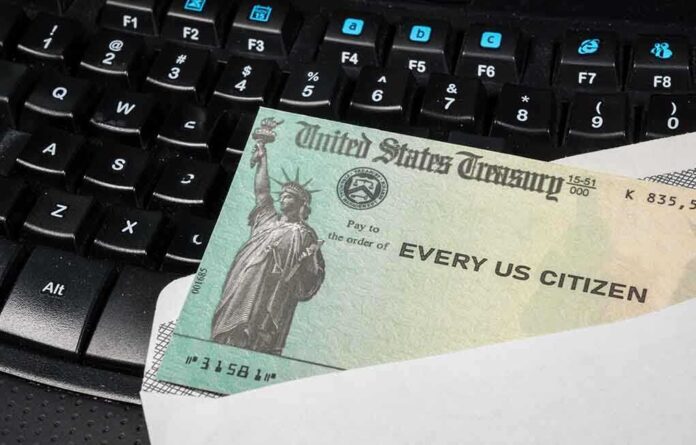
President Trump’s proposed $2,000 tariff-funded “dividend” checks face significant hurdles, leaving many Americans questioning the reality of this promise.
Story Highlights
- President Trump proposes $2,000 checks funded by tariffs, but lacks formal plan or legislation.
- Tariff revenues fall short of covering proposed payments, creating financial concerns.
- Congressional approval is necessary, with no current direct deposit mechanism in place.
- Economic experts warn of potential inflation and complications for Federal Reserve policies.
Trump’s Tariff Dividend Proposal
In 2026, President Trump announced a plan to distribute $2,000 checks to most Americans, funded by revenues from tariffs on imports. This move is framed as a way to return tariff profits to middle- and lower-income households and is part of Trump’s broader economic agenda to boost U.S. prosperity. However, no formal plans or legislation have been introduced, and experts highlight the significant hurdles ahead, including the need for congressional approval.
Despite Trump’s promises, the proposed tariff revenues are insufficient to cover the costs of these checks. The Tax Foundation projects that tariff collections, estimated at $207.5 billion for 2026, fall short of the $279.8 billion to $606.8 billion needed to fund the payments. This discrepancy raises questions about the sustainability and feasibility of the plan, which could lead to increased national debt without careful fiscal management.
Congressional and Legal Challenges
For Trump’s proposal to become a reality, congressional approval is crucial. The president lacks the unilateral authority to spend funds without legislative backing. This poses a significant challenge, as Republicans in Congress may have fiscal concerns regarding the potential impact on the deficit. Additionally, the legality of the tariffs themselves is being scrutinized, with pending Supreme Court cases that could require refunds to importers if the tariffs are deemed unlawful.
Furthermore, the promise of $2,000 checks echoes past unfulfilled promises, such as the “DOGE dividends” linked to Elon Musk’s efficiency cuts and first-term infrastructure promises. Critics highlight the lack of a concrete direct deposit mechanism through the IRS, which was instrumental in past stimulus check distributions.
Economic and Social Implications
The prospect of $2,000 tariff-funded checks has generated significant public interest, particularly among middle- and lower-income households. However, experts warn of potential inflation if billions are injected into the economy without careful management. This could complicate Federal Reserve policies aimed at maintaining economic stability.
While Trump’s proposal aims to bolster his base by presenting tariffs as a patriotic payback, the economic realities and legal complexities cast doubt on the feasibility of delivering on this promise. Without a clear plan and legislative support, the hype surrounding these payments may lead to public frustration and skepticism.
Sources:
Time – Trump’s Stimulus Checks Payment for Americans
Fox5DC – Stimulus Payment January 2026 Fact Check
Kiplinger – Are New Trump Payments Coming?
Northeastern University – Trump’s Tariff Stimulus Checks and Inflation Risks